Showing posts with label suspension system. Show all posts

Wednesday, 17 August 2016

Types of suspension system part2

SOLID-AXLE, LEAF-SPRING


The drive axle is clamped to the leaf springs and the shock absorbers normally bolt directly to the axle. The ends of the leaf springs are attached directly to the chassis, as are the tops of the shock absorbers. Simple, not particularly elegant, but cheap. The main drawback with this arrangement is the lack of lateral location for the axle, meaning it has a lot of side-to-side slop in it.

Leaf springs:

The spring consist of a number of leaves called blades. The blades vary in length and connected together as shown in the figure. These springs based on the theory of beam of uniform strength.

This spring is mounted on the axle by the U bolt and the one end of spring is mounted on the frame and other is connected with a shackle which allow to change in length between eye of spring when the vehicle come across projection of road and upward movement of wheel.
When there is wide range of loading on vehicle helper spring is also provided with the leaf spring which increase the weight loading capacity of vehicle.


Types of leaf springs are 1)elliptic:
                                         2)semi-elliptic:


                                            3) quater elliptic:
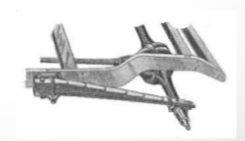

                                             4)Three quater elliptic:
SOLID-AXLE, COIL-SPRING

The basic idea is the same, but the leaf springs have been removed in favour of either 'coil-over-oil' spring and shock combos, or as shown here, separate coil springs and shock absorbers. Because the leaf springs have been removed, the axle now needs to have lateral support from a pair control arms. The front ends of these are attached to the chassis, the rear ends to the axle.
ref:www.carbible.com
Tuesday, 16 August 2016

Types of supension system part1

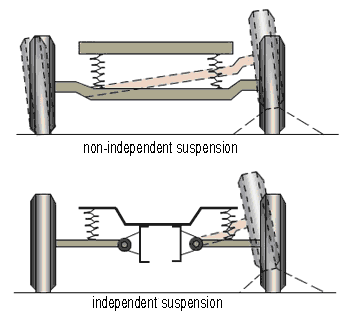
 1)Dependent Suspension - It is a type of suspension in which left and right suspension are linked together and disturbance on one side is transferred to other side.
    Independent Suspension - It is a type of suspension in which left and right suspension are not linked together and disturbance on one side is not transferred to other side.
Independent suspension is classified into
                                                                                                 1).MacPherson Strut
                                                                                                 2).Double Wishbone

 1).MacPherson Strut: The MacPherson strut combines a shock absorber and a coil spring into a single unit. This provides a more compact and lighter suspension system that can be used for front-wheel drive vehicles.


 2).Double Wishbone:This is classified into

  a) COIL SPRING TYPE 1:
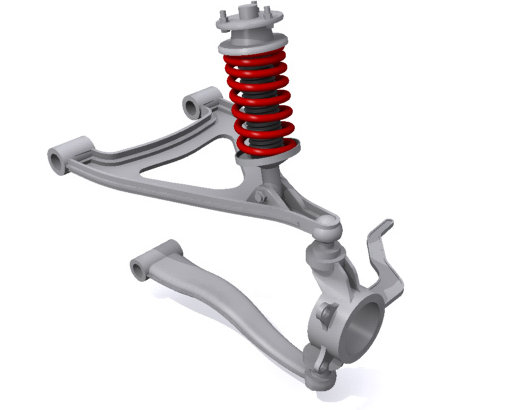
    This is a type of double-A or double wishbone suspension. The wheel spindles are supported by an upper and lower 'A' shaped arm.In this type, the lower arm carries most of the load. If you look head-on at this type of system, what you'll find is that it's a very parallelogram system that allows the spindles to travel vertically up and down. When they do this, they also have a slight side-to-side motion caused by the arc that the wishbones describe around their pivot points. This side-to-side motion is known as scrub.Unless the links are infinitely long the scrub motion is always present. There are two other types of motion of the wheel relative to the body when the suspension articulates.


 b) COIL SPRING TYPE 2:This is also a type of double-A arm suspension although the lower arm in these systems can sometimes be replaced with a single solid arm . The only real difference between this and the previous system mentioned above is that the spring/shock combo is moved from between the arms to above the upper arm. This transfers the load-bearing capability of the suspension almost entirely to the upper arm and the spring mounts. The lower arm in this instance becomes a control arm

c)Multi link suspension:The basic principle of it is the same, but instead of solid upper and lower wishbones, each 'arm' of the wishbone is a separate item. These are joined at the top and bottom of the spindle thus forming the wishbone shape. The super-weird thing about this is that as the spindle turns for steering, it alters the geometry of the suspension by torquing all four suspension arms. 

    There are a lot of variations on this theme appearing at the moment, with huge differences in the numbers and complexities of joints, numbers of arms, positioning of the parts etc. but they are all fundamentally the same.
d)trailing arm suspension:The trailing arm system is literally that - a shaped suspension arm is joined at the front to the chassis, allowing the rear to swing up and down. Pairs of these become twin-trailing-arm systems and work on exactly the same principle as the double wishbones in the systems described above. The difference is that instead of the arms sticking out from the side of the chassis, they travel back parallel to it. This is an older system not used so much any more because of the space it takes up.

e)twin I beam suspension:This is a combination of trailing arm suspension and solid beam axle suspension. Only in this case the beam is split in two and mounted offset from the centre of the chassis, one section for each side of the suspension. The trailing arms are actually (technically) leading arms and the steering gear is mounted in front of the suspension setup. 
ref:www.carbible.com


Suspension system

 Suspension system : The automobile frame and body are mounted on the front and
rear axle not directly but through the springs and shock absorbers. The
assembly of parts, which perform the isolation of parts from the road shocks,
may be in the forms of bounce, pitch and roll is called suspension system.
Basic parts of suspension system:
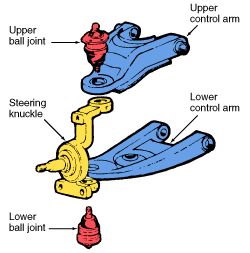
1)control arm: Movable lever that fastens the steering knuckle to the vehicl body or frame.
2)Steering knuckle:Provides a spindle or bearing support for the wheel hub,bearings and wheel assembly.

3)Ball joints:Swivel joints that allow control arm and steering knuckle to move up and down and side to side
4)Springs:Supports the weight of the vehicle;permits the control arm and wheel to move up and down.
5)Shock absorbers(or)dampers:Keeps the suspension from coutinuing to bounce after spring compression and extension.
6)control arm bushings:Sleeves that allow the control arm to swing up and down on the frame.

Suspension Terminology

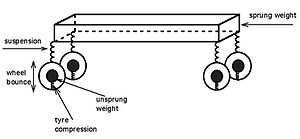
1)Sprung Weight: It is weight of all the parts supported by the spring including
weight of the spring.
   Un sprung weight: It is the weight of all the parts between the spring and rod
and the portion of spring weight it self.

Basic suspension movements:
1. Bouncing: The vertical movement of the complete body.
2. Pitching: The rotating movement of all the parts between the spring
and road and the portion of spring weight itself.
3. Rolling: The movement about longitudinal axis produced by the
centrifugal force during cornering.

2)Jacking Forces - Jacking forces are the sum of the vertical force components experienced by the suspension links. The resultant force acts to lift the sprung mass if the roll center is above ground, or compress it if underground. Generally, the higher the roll center, the more jacking force is experienced.
3)Spring Rate - The spring rate (or suspension rate) is a component in setting the vehicle's ride height or its location in the suspension stroke. When a spring is compressed or stretched, the force it exerts is proportional to its change in length. The spring rate or spring constant of a spring is the change in the force it exerts, divided by the change in deflection of the spring.

4)Travel-It is the measure of distance from the bottom of the suspension stroke (such as when the vehicle is on a jack and the wheel hangs freely) to the top of the suspension stroke (such as when the vehicle's wheel can no longer travel in an upward direction toward the vehicle).

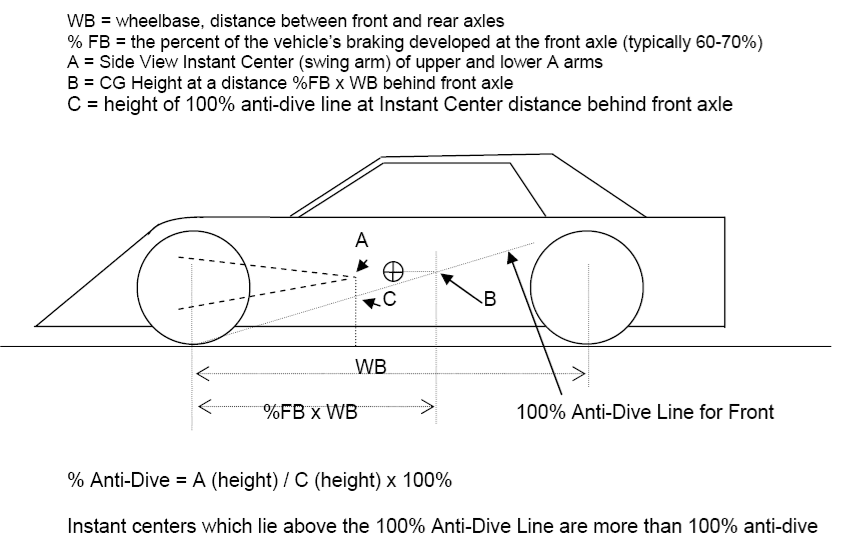
5) Anti dive:
Anti Dive describes the amount the front of the vehicle Dives under breaking. As the brakes are applied, weight is transferred to the front and that forces the front to dive. Anti Dive is dependant on the vehicles center of gravity, the percentage of braking force developed at the front tires vs the rear, and the design of the front suspension. 
    Anti squat:Antisquat (A/S) is one of those mechanical tools that can add traction off the corners when used properly.