


COOMING SOON
Wednesday, 10 August 2016
CHASSIS
Chassis is a French term and was initially used
to denote the frame parts or Basic Structure of the vehicle. It is the back bone
of the vehicle. A vehicle with out body is called Chassis. The components of
the vehicle like Power plant, Transmission System, Axles, Wheels and Tyres,
Suspension, Controlling Systems like Braking, Steering etc., and also electrical
system parts are mounted on the Chassis frame. It is the main mounting for all
the components including the body. So it is also called as Carrying Unit.
 |
| chassis |
TYPES OF CHASSIS
1)LADDER FRAME CHASSIS
2)TUBULAR SPACE FRAME CHASSIS
3)MONOCOQUE FRAME CHASSIS
4)ULSAB MONOCOQUE
5)BACKBONE FRAME CHASSIS
6)ALUMINIUM SPACE FRAME
7)CARBON FIBRE MONOCOQUE
reference:www.autozine.org
Ladder space frame chassis
- They look like a ladder - two longitudinal rails interconnected by several lateral and cross braces. The longitude members are the main stress member. They deal with the load and also the longitudinal forces caused by acceleration and braking. The lateral and cross members provide resistance to lateral forces and further increase torsional rigidity.

reference:www.autozine.org
Tubular space frame chassis
- Tubular space frame chassis employs dozens of circular-section tubes (some may use square-section tubes for easier connection to the body panels, though circular section provides the maximum strength), position in different directions to provide mechanical strength against forces from anywhere. These tubes are welded together and forms a very complex structure.
For higher strength required by high performance sports cars, tubular space frame chassis usually incorporate a strong structure
reference:www.autozine.org
Monocoque
- Monocoque is a one-piece structure which defines the overall shape of the car. While ladder, tubular space frame and backbone chassis provides only the stress members and need to build the body around them, monocoque chassis is already incoporated with the body in a single piece
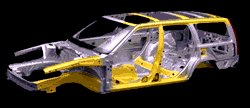
In fact, the "one-piece" chassis is actually made by welding several pieces together. The floorpan, which is the largest piece, and other pieces are press-made by big stamping machines. They are spot welded together by robot arms (some even use laser welding) in a stream production line. The whole process just takes minutes. After that, some accessories like doors, bonnet, boot lid, side panels and roof are added.
Monocoque chassis also benefit crash protection. Because it uses a lot of metal, crumple zone can be built into the structure.
- reference:www.autozine.org
Ulsab monocoque
- Ultra Light Steel Auto Body (ULSAB). As shown in the picture, basically it has the same structure as a conventional monocoque. it the use of "Hydroform" parts, sandwich steel and laser beam welding.
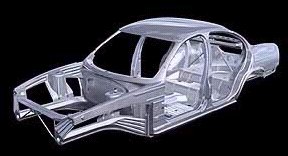
Hydroform is a new technique for shaping metal to desired shape, alternative to pressing. Conventional pressing use a heavy-weight machine to press a sheet metal into a die, this inevitably creates inhomogenous thickness - the edges and corners are always thinner than surfaces. To maintain a minimum thickness there for the benefit of stiffness, car designers have to choose thicker sheet metal than originally needed. Hydroform technique is very different. Instead of using sheet metal, it forms thin steel tubes. The steel tube is placed in a die which defines the desired shape, then fluid of very high pressure will be pumped into the tube and then expands the latter to the inner surface of the die. Since the pressure of fluid is uniformal, thickness of the steel made is also uniformal. As a result, designers can use the minimum thickness steel to reduce weight.
Sandwich steel is made from a thermoplastic (polypropylene) core in between two very thin steel skins. This combination is up to 50 percent lighter compared with a piece of homogenous steel without a penalty in performance. Because it shows excellent rigidity, it is applied in areas that call for high bending stiffness. However, it cannot be used in everywhere because it needs adhesive bonding or riveting instead of welding.
- reference:www.autozine.org
Backbone chassis
- Backbone chassis is very simple: a strong tubular backbone (usually in rectangular section) connects the front and rear axle and provides nearly all the mechnical strength. Inside which there is space for the drive shaft in case of front-engine, rear-wheel drive layout. The whole drivetrain, engine and suspensions are connected to both ends of the backbone. The body is built on the backbone, usually made of glass-fibre.

It's strong enough for smaller sports cars but not up to the job for high-end ones. In fact
- reference:www.autozine.org
Subscribe to:
Posts (Atom)